

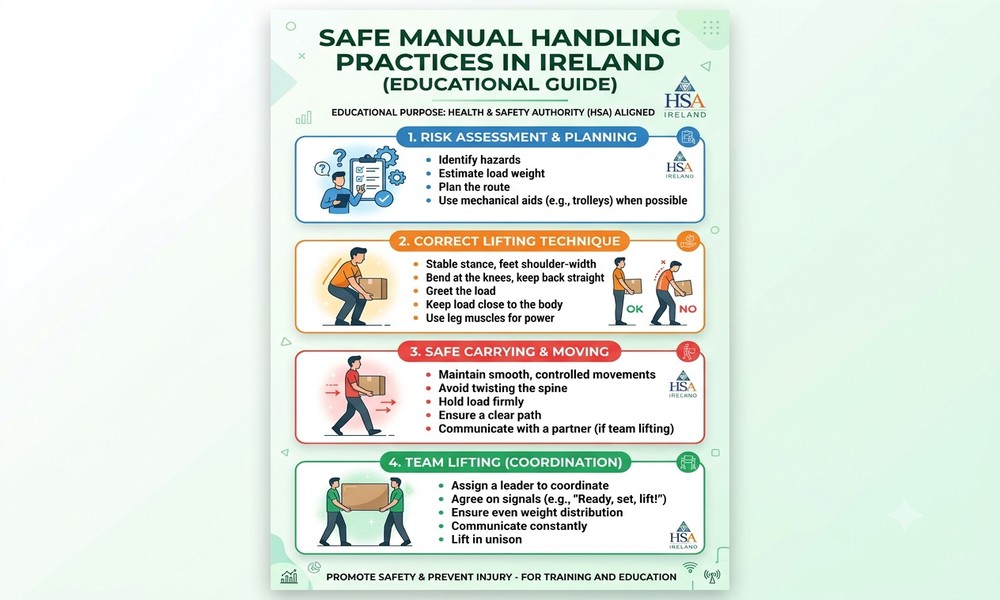
Manual handling Ireland is one of the leading causes of workplace injury across Ireland. Whether you work in construction, healthcare, retail, or an office environment, understanding correct manual handling techniques is not just good practice – it is a legal requirement. In Ireland, employers are legally obliged under the Safety, Health and Welfare at Work (General Application) Regulations 2007 to ensure their workforce receives proper training. This article provides a comprehensive guide to manual handling in Ireland, covering the law, training requirements, common mistakes, and best practices to keep workers safe and businesses compliant.
Definition: Any transporting or supporting of a load by one or more employees using bodily force
Legal Basis: Safety, Health and Welfare at Work (General Application) Regulations 2007
Key Body: Health and Safety Authority (HSA) of Ireland
Training Required: Yes – employers must provide task-specific manual handling instruction
Why It Matters: Musculoskeletal disorders (MSDs) account for a large portion of workplace injuries reported annually in Ireland
Understanding Manual Handling in Ireland
Manual handling encompasses a wide range of physical activities performed in everyday work. In the Irish context, it is defined broadly to include lifting boxes in a warehouse, assisting patients in a care home, stacking shelves in a supermarket, and even prolonged sitting or repetitive motion tasks in an office.
The Health and Safety Authority (HSA) is the national body responsible for enforcing workplace health and safety legislation in Ireland. Under their oversight, employers must complete a formal ergonomic risk assessment for all manual handling tasks and implement controls to minimise injury risk.
The key legislative framework – the Safety, Health and Welfare at Work Act 2005 and associated General Application Regulations 2007 – places a duty of care on employers to eliminate or reduce manual handling risks as far as is reasonably practicable. Where risk cannot be eliminated, adequate training must be provided.
This training is relevant across virtually every industry in Ireland: healthcare, logistics, hospitality, construction, agriculture, retail, and the public sector. Injuries from improper manual handling – primarily back injuries, shoulder strain, and hernias – can have long-lasting consequences for workers and significant financial and legal implications for employers.
Key Benefits of Proper Manual Handling Training
- Reduces workplace injuries: Correct training dramatically lowers the incidence of musculoskeletal disorders, protecting employees from chronic back pain, joint damage, and repetitive strain injuries that can sideline workers for weeks or months.
- Ensures full legal compliance: Certified manual handling training demonstrates that employers have met their obligations under Irish law, reducing the risk of HSA enforcement action, fines, or prosecution.
- Boosts employee confidence: Workers who understand safe techniques are more confident, move more efficiently, and are less likely to take unplanned sick days related to injury.
- Reduces business costs: Fewer injuries mean lower absenteeism, reduced insurance premiums, fewer compensation claims, and better overall productivity – all directly benefiting the bottom line.
- Improves workplace culture: Investing in safety training signals to staff that their wellbeing is valued, increasing morale, engagement, and staff retention rates.
- Supports risk management: Manual handling risk assessments provide documented evidence of due diligence, which is invaluable in the event of a workplace incident or legal dispute.
- Customisable to your industry: Effective training can be tailored to the specific loads, environments, and tasks relevant to your workforce, making it immediately practical and applicable.
Step-by-Step Guide to Safe Manual Handling
- Assess the load before lifting – Before attempting to move any object, check its weight, size, shape, and stability. Look for handholds, check for sharp edges, and identify any potential hazards along your path of travel.
- Plan your route – Clear the area of obstacles. Ensure the destination is prepared to receive the load. Know where you are going before you pick up the object to avoid awkward adjustments mid-lift.
- Position your body correctly – Stand close to the load with your feet shoulder-width apart. Bend at the knees – not the waist – and keep your back straight and your core muscles gently engaged.
- Grip and lift smoothly – Grip the load firmly using the whole hand, not just the fingers. Lift gradually using your leg muscles, keeping the load close to your body throughout. Avoid sudden jerking movements.
- Move and set down safely – Walk steadily to your destination. To lower the load, reverse the lifting technique: bend the knees, keep the back straight, and place the load down with control. Never twist the spine while carrying.
Important Statistics and Industry Insights
Manual handling injuries remain among the most commonly reported workplace injuries in Ireland. According to data from the Health and Safety Authority, musculoskeletal disorders consistently account for a significant proportion of workplace illness and injury reports submitted annually.
- Back injuries are the most common result of manual handling incidents, accounting for a substantial share of all work-related musculoskeletal cases in the country.
- Healthcare and social work sectors report some of the highest rates of manual handling incidents in Ireland, given the regular requirement for patient handling and repositioning.
- Hospitality, construction, and retail also feature prominently in manual handling injury statistics, particularly involving repetitive lifting and carrying tasks.
- Across Europe, the EU-OSHA has identified musculoskeletal disorders as the most widespread occupational health problem, affecting millions of workers, which underscores the importance of national compliance efforts such as those led by the HSA.
- Research indicates that investing in manual handling training and ergonomic improvements can reduce workplace injuries by up to 40%, delivering a strong return on investment for employers.
- Remote and hybrid work has not eliminated manual handling risk – sedentary office work and improper workstation setup remain contributors to upper limb and back complaints in Ireland.
Common Mistakes to Avoid
- Bending at the waist instead of the knees: This is the single most common cause of lower back injury. Workers frequently lift without engaging their legs, placing enormous strain on the lumbar spine. Training must reinforce the correct squat technique repeatedly.
- Ignoring load weight limits: Individuals often attempt to carry objects that are too heavy without asking for assistance or using mechanical aids. Employers should clearly label load weights and provide trolleys, hoists, or team-lift protocols.
- Twisting while carrying a load: Rotating the spine while holding a heavy item dramatically increases injury risk. Employees should pivot their feet instead of twisting their torso to change direction.
- Skipping risk assessments: Many businesses treat manual handling training as a tick-box exercise without completing proper ergonomic risk assessments first. Without a risk assessment, training may not address the actual hazards present in the workplace.
- Providing generic rather than task-specific training: Off-the-shelf training courses may not reflect the specific loads, environments, or physical demands of your workplace. Training should always be tailored to real job tasks.
- Failing to refresh training: Manual handling competence deteriorates over time, especially as job roles change. Irish best practice recommends refresher training every two to three years, or whenever a significant change in work activities occurs.
- Neglecting to report minor incidents: Small strains and discomforts are often ignored, allowing conditions to worsen into serious, long-term injuries. Encouraging prompt reporting enables early intervention and supports continuous risk management.
Expert Recommendations
Leading occupational health and safety professionals advise the following best practices for employers and employees across Ireland:
- Conduct a formal ergonomic risk assessment before implementing or reviewing a manual handling programme. Use the HSA’s published guidance documents to structure this process correctly.
- Choose a reputable, accredited training provider whose courses meet the requirements of the Safety, Health and Welfare at Work (General Application) Regulations 2007. Look for trainers with QQI qualifications or equivalent recognised credentials.
- Integrate manual handling awareness into everyday management conversations – safety should not be limited to formal training days. Brief toolbox talks and daily reminders reinforce good habits.
- Invest in mechanical handling aids wherever possible. Trolleys, pallet jacks, hoists, and adjustable workstations reduce the need for manual force and significantly lower injury risk.
- Maintain training records meticulously. In the event of an HSA inspection or a personal injury claim, documentary evidence of training completion is essential.
- Regularly review and update your manual handling risk assessments as duties evolve, new staff join, or work environments change.
Frequently Asked Questions
1. What is manual handling training in Ireland?
Manual handling training in Ireland is a legally required programme that teaches employees how to safely lift, carry, push, and pull loads. It must be task-specific and is governed by the Safety, Health and Welfare at Work (General Application) Regulations 2007. Training is delivered by qualified instructors and typically includes both theory and practical components.
2. Is manual handling training a legal requirement in Ireland?
Yes. Irish law requires employers to provide appropriate manual handling training to any employee whose role involves such activities. Failure to comply can result in enforcement action by the Health and Safety Authority (HSA), including fines or prosecution.
3. How long does a manual handling course take in Ireland?
A standard manual handling training course in Ireland typically lasts between three and four hours, covering theoretical principles and practical technique. Refresher courses are generally shorter. The exact duration may vary depending on the industry, the complexity of tasks involved, and the training provider.
4. How often should manual handling training be refreshed?
Best practice in Ireland recommends refresher training every two to three years. Training should also be updated whenever an employee’s role changes significantly, new equipment is introduced, or following a workplace incident involving manual handling.
5. What legislation governs manual handling in Ireland?
The primary legislation is the Safety, Health and Welfare at Work (General Application) Regulations 2007, Chapter 4 of Part 2, which deals specifically with manual handling of loads. The overarching Safety, Health and Welfare at Work Act 2005 also applies, requiring employers to manage all foreseeable workplace risks.
Conclusion
Manual handling in Ireland is a critical workplace safety topic that affects employees across every sector of the economy. With musculoskeletal injuries consistently ranking among the most prevalent work-related health issues, proper training, risk assessment, and management commitment are essential.
The key takeaway is clear: Irish law requires employers to take manual handling seriously. That means conducting proper risk assessments, providing certified, task-specific training, investing in mechanical aids where possible, and keeping training records up to date.
Looking ahead, the emphasis on ergonomics and worker wellbeing will only grow stronger. EU-wide directives, rising insurance costs, and increasing employee awareness mean that businesses that act proactively on manual handling will be better positioned for long-term success.
