

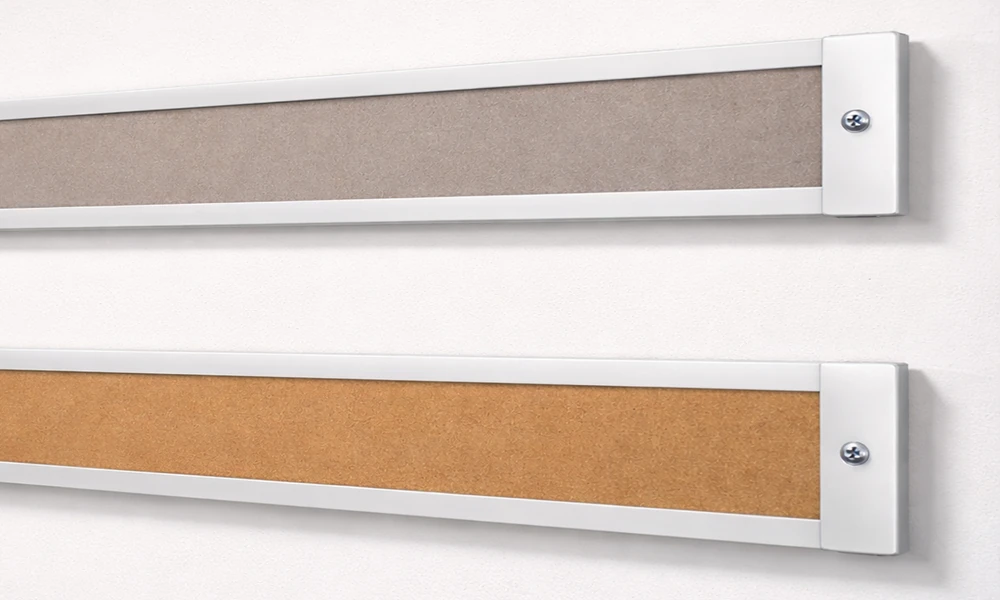
Map rails and display accessories add flexibility, organization, and extra display capacity to instructional walls by giving teachers ways to hang maps, charts, posters, and student work above or alongside writing surfaces. These small components turn a basic whiteboard into a complete teaching wall.
The United States has more than 13,000 public school districts (National Center for Education Statistics).
What is a map rail?
A map rail is a horizontal strip mounted along the top of a whiteboard, chalkboard, or wall that holds maps, charts, and papers using hooks or clips. Map rails commonly include a cork insert that accepts pins.
Why map rails endure
Map rails have been part of classrooms for generations. They remain useful because they add display space without covering the writing surface.
What display accessories are commonly available?
Commonly available display accessories include map rails, display rails, marker trays, map hooks, roller brackets, flag holders, and paper clips. Each supports a different way of presenting information.
Common accessory types
- Map rails with cork inserts for pinning papers
- Display rails with clips for hanging charts
- Marker trays for storing markers and erasers
- Map hooks for hanging roll-down maps and charts
- Roller brackets for pull-down maps or screens
- Flag holders for classroom flags
Which accessories attach to display rails
Display rails accept 3 common accessory types, map hooks, roller brackets, and flag holders, which extend what a single rail can hold (ASI Visual Display Products).
How do accessories improve classroom organization?
Accessories improve classroom organization by giving materials a designated place on the wall, which keeps the writing surface clear and reduces clutter. Teachers can display reference materials without taping them to the board.
Organizational benefits
- Writing surfaces stay clear for instruction
- Reference materials remain visible during lessons
- Markers and erasers stay within reach
- Display changes are quick and easy
- Walls look more orderly and intentional
Clear, organized walls help students focus on the content that matters most during a lesson.
How do map rails support instruction?
Map rails support instruction by keeping key visual aids, such as maps, timelines, vocabulary charts, and anchor charts, in view throughout a unit. Students can reference them while working.
Subjects that rely on visual references
Teachers of history, geography, science, and language arts rely on visual references. A map rail keeps those references accessible without taking up writing space. Rotating displays by unit keeps the wall current.
How should accessory height be planned?
Accessory height should be planned so that teachers can reach display rails and marker trays comfortably, and so that students can see displayed materials from their seats. Placement that is too high limits use.
Height and accessibility
Height planning also affects accessibility. Reach ranges and operable parts are addressed in the 2010 ADA Standards, which shapes how users of different heights and abilities interact with marker trays and display features (U.S. Department of Justice). Confirming applicable provisions with the authority having jurisdiction is part of good planning.
Height considerations
- Marker tray height for comfortable writing
- Display rail height for visibility across the room
- Reach for teachers and students changing displays
- Clearance above boards for maps and charts
- Coordination with projectors and screens
How do accessories fit with technology in classrooms?
Accessories fit with technology in classrooms by complementing interactive displays and projectors rather than competing with them. Roller brackets can hold pull-down screens, and display rails can frame digital displays with printed references.
Whiteboards beside interactive panels
Classrooms with interactive panels often keep whiteboards beside them for spontaneous writing. Accessories help integrate both tools into a unified teaching wall.
What materials are used in display accessories?
Display accessories are commonly made from aluminum with durable finishes that match whiteboard frames. Cork inserts provide pinnable surfaces, and steel or plastic components form hooks and clips.
Matching finishes
Matching finishes between frames and accessories creates a cohesive look. Durable materials hold up to frequent display changes over a long service life.
How should accessories be added to existing boards?
Accessories can be added to existing boards by mounting rails and trays to compatible frames or directly to the wall. Framed board systems commonly accept accessories designed for the same series.
Upgrade steps
- Identify the existing board frame type
- Select compatible rails and accessories
- Measure board width for rail length
- Mount accessories securely to frames or walls
- Arrange displays for visibility and reach
Retrofitting accessories is a low-cost way to refresh a classroom without replacing the board itself. Supportive learning environments depend in part on the instructional tools teachers use every day (U.S. Department of Education).
How should display accessories be maintained?
Display accessories should be maintained by cleaning cork inserts, checking hooks and clips for wear, and tightening mounting hardware. Replacing worn cork keeps map rails functional.
Maintenance tips
- Remove old pins and staples from cork inserts
- Replace cork strips that no longer hold pins
- Tighten rail mounting screws periodically
- Replace missing hooks and clips
- Clean marker trays regularly
How do accessories support different grade levels?
Accessories support different grade levels by adapting the wall to the materials each age group uses. Elementary classrooms often rely on display rails for anchor charts, alphabet strips, and calendars, while secondary classrooms use map rails and roller brackets for maps, periodic tables, and subject-specific references.
Standardizing accessory packages
Planning accessory packages by grade level helps districts standardize purchases while still meeting classroom needs. Teachers moving between rooms find familiar layouts, and replacement parts remain consistent across buildings.
Why do accessories matter for instructional walls?
Accessories matter for instructional walls because they expand what a board can do without adding new wall surfaces. They help teachers organize materials, display references, and keep writing space clear.
The complete teaching station
A whiteboard with the right accessories becomes a complete teaching station. Small components make a measurable difference in how effectively a classroom wall supports daily instruction.
